
Raising Rent in Wisconsin Without Losing a Good Tenant
Raising rent in Wisconsin is legal, and there’s no cap on the amount. But there is a right way and a wrong way to do it, both legally and practically.
The legal rules first
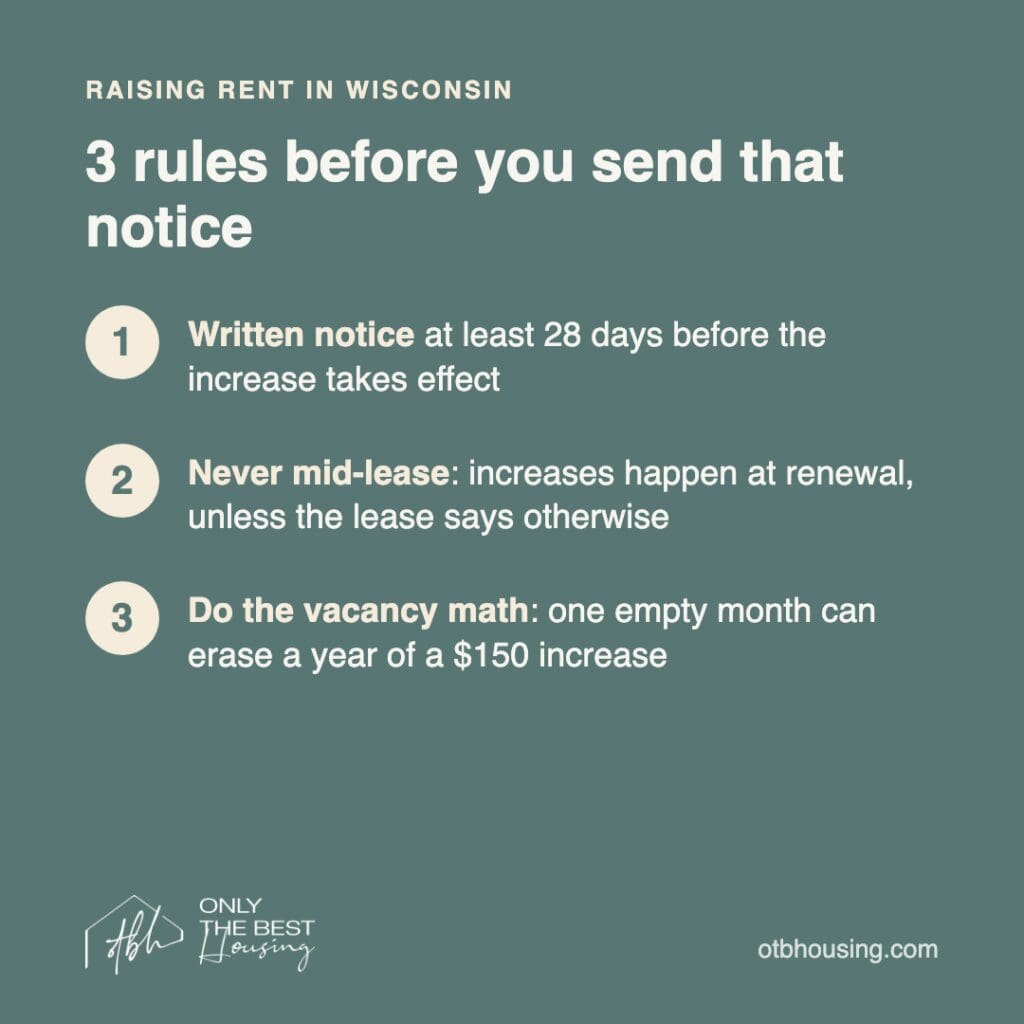
1. Written notice, at least 28 days in advance. Wisconsin requires written notice at least 28 days before a rent increase takes effect, under the framework of Wis. Stat. 704.19. The notice should clearly state the new amount and the date it starts. While a text message can be used to provide an additional notice, it cannot replace a written notice. Put it in writing, dated, and keep a copy.
2. No mid-lease increases. If your tenant signed a 12-month lease at $1,100, that’s the rent until the lease ends, unless the lease itself specifically allows a change. Increases happen at renewal. Month-to-month tenancies can be increased more often, but each increase still needs that 28-day written notice.
3. No retaliatory increases. You cannot raise rent to punish a tenant for exercising their legal rights, like complaining about a needed repair or contacting a building inspector (Wis. Stat. 704.45). Madison goes further: a rent increase within six months of certain tenant actions can be presumed retaliatory. If you own in Madison, time your increases carefully and document your reasons.
4. No discriminatory increases. Raising rent based on race, religion, family status, age, or any other protected class violates fair housing law. Raise by unit and market, not by who lives there.
Deciding the amount
The legal rules are the easy part. The harder question is what increase actually offsets costs and provides additional income.
A vacant month usually costs more than a modest increase earns. Say your tenant pays $1,100 and you push to $1,250. If they leave, you’re likely looking at least a month vacant plus turnover costs: cleaning, touch-up paint, marketing, screening. One empty month alone is $1,100 to $1,250 gone. That aggressive $150 increase needs most of a year just to break even against a single vacant month, and that’s if the market supports the new price.
Check what your market is doing before you decide. We track asking rents across ten Wisconsin cities often, and right now the picture is genuinely mixed. Some Fox Valley markets have climbed noticeably in three months, while Madison, the state’s priciest market, has gone flat this summer. A $100 increase might be below-market in one city and a tenant-loser in another.
Good tenants know what they’re worth. Someone who pays on time and takes care of the place is cheap to keep and expensive to replace. Market-rate increases in small, predictable steps beat surprise jumps every time.
A renewal playbook that works
1. Start 60 to 90 days before lease end. That gives you room for the 28-day notice with time to talk first, and gives the tenant time to decide without panic.
2. Check the comps. What are similar units in your city actually asking right now? Not last year.
3. Lead with the renewal, not the increase. “We’d love to have you stay another year; here are the new terms” lands better than a bare notice.
4. Put it in writing. The new amount, the effective date, and the ask for a response by a specific date. Keep copies of everything.
5. Know your walk-away math. Before negotiating, know what a vacant month costs you. It usually makes a $25 compromise easy.
The bottom line
Wisconsin gives owners a lot of freedom on rent. No caps, no rent control. The 28-day written notice, the mid-lease rule, and the retaliation ban are the legal lines to respect. The rest is judgment: price to your actual market, value your good tenants, and do the vacancy math before you chase an extra $100.
Sources: Wis. Stat. 704.19 · Wis. Stat. § 704.45 · Steadily: Rent Increase Laws in Wisconsin (2026)
This article is general information, not legal advice.
Not sure what your property should rent for this year? Only The Best Housing handles the time-consuming, legally sensitive parts of renting, including pricing, renewals, and compliant notices, while you stay in charge. Request a consultation at otbhousing.com or call (920) 931-2602.